


18, Sep 2026
oneworld Named World’s Best Airline Alliance at the 2026 Skytrax Awards
LONDON, Sept. 18, 2026 /PRNewswire/ — oneworld® has been named ‘World’s Best Airline Alliance’ at the 2026 Skytrax World Airline Awards. Presented in London on 18 September 2026, the recognition marks oneworld’s fifth win in the annual awards known as the ‘Oscars of the aviation industry.’
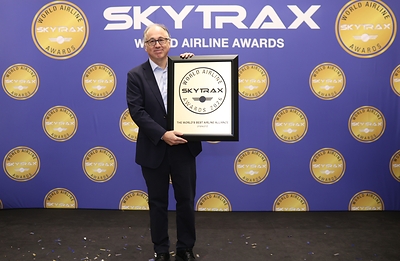
“We are honoured to be awarded World’s Best Airline Alliance by Skytrax,” said Luis Gallego, CEO of International Airlines Group (IAG) and Chairman of the oneworld Governing Board, collecting the award. “This prestigious award reflects how oneworld’s continued commitment to creating a more connected and rewarding journey is valued by global travellers.”
Skytrax award winners are determined through a large-scale customer satisfaction survey, with millions of travellers rating their travel experiences across airlines and airports worldwide.
“This recognition is acknowledgment of the elevated, consistent experience our member airlines provide to customers around the world each day, as oneworld leads the industry in customer benefits, loyalty, sustainability initiatives and more,” said Ole Orver, CEO of oneworld. “With the best premium offerings in the world, including First Class lounge access, we are honored that customers see the considered care with which our member airlines deliver service.”
About oneworld:
oneworld brings together 15 world-class airlines – Alaska Airlines/Hawaiian Airlines, American Airlines, British Airways, Cathay Pacific, Fiji Airways, Finnair, Iberia, Japan Airlines, Malaysia Airlines, Oman Air, Qantas, Qatar Airways, Royal Air Maroc, Royal Jordanian and SriLankan Airlines to nearly 1,000 destinations. oneworld member airlines work together to consistently deliver a superior, consistent travel experience, with special rewards and privileges for its frequent flyers, including earning and redeeming miles and points across the entire alliance network, access to airport lounges, priority check in and boarding and extra baggage allowances and more. Learn more about the oneworld Alliance at oneworld.com. Follow us on Facebook, Instagram, X and LinkedIn.
Media Contact:
press@oneworld.com

 View original content to download multimedia:https://www.prnewswire.co.uk/news-releases/oneworld-named-worlds-best-airline-alliance-at-the-2026-skytrax-awards-302883339.html

- 0
- By Sai Krishna

18, Sep 2026
RBI Absorbs Rs 2.23 Lakh Crore Through VRRR as Banking System Remains Flush With Funds
MUMBAI, September 18, 2026: The Reserve Bank of India stepped up its liquidity management operations on Friday, absorbing Rs 2.23 lakh crore from the banking system through a three-day Variable Rate Reverse Repo (VRRR) auction, as surplus funds continued to remain elevated across banks.
The central bank received bids worth Rs 2,22,629 crore against a notified amount of Rs 2.25 lakh crore and accepted the entire amount offered by participating banks. The funds were absorbed at a cut-off and weighted average rate of 5.24 per cent.
The operation is part of the RBI’s ongoing efforts to manage excess liquidity and keep overnight money-market rates aligned with its policy stance. The three-day funds parked with the central bank are scheduled to reverse on September 21, making the operation a temporary liquidity-management measure rather than a permanent withdrawal of money from the financial system.
The latest auction comes against the backdrop of a sizeable liquidity surplus in the banking system. RBI data showed that surplus liquidity stood at approximately Rs 6.94 lakh crore as of September 17.
The figure, however, represents a moderation from the estimated surplus of around Rs 10.73 lakh crore on September 11, indicating that recent RBI operations have already absorbed a significant amount of excess funds.
For the central bank, the challenge is to ensure that abundant liquidity does not push short-term market rates materially away from the policy repo rate. VRRR operations provide the RBI with a flexible mechanism to temporarily take excess funds out of circulation while allowing banks to earn a return on the money parked with the central bank.
Under a Variable Rate Reverse Repo operation, banks bid to place surplus funds with the RBI for a specified period. Unlike a fixed-rate reverse repo, the interest rate is determined through the auction process.
The mechanism allows the RBI to calibrate liquidity conditions according to prevailing market requirements. When surplus cash is high, banks have less incentive to borrow from one another, which can place downward pressure on overnight money-market rates.
By absorbing excess funds, the RBI can help maintain closer alignment between short-term market rates and the policy repo rate, thereby supporting the transmission of monetary policy.
The latest VRRR auction is not an isolated liquidity operation. The RBI has also been using open market operations to absorb surplus funds from the banking system.
On Thursday, the central bank sold government securities worth Rs 50,000 crore through an OMO auction. Two additional government-security sales of Rs 25,000 crore each have been scheduled for September 21 and September 28.
The combination of VRRR operations and OMO sales gives the RBI different tools to address liquidity conditions over varying time horizons. While a VRRR operation temporarily absorbs funds, an OMO sale involves the outright sale of government securities.
One of the factors contributing to the current liquidity surplus has been strong mobilisation of Foreign Currency Non-Resident (Bank), or FCNR(B), deposits.
Subsequent currency swaps with the RBI have released additional rupee liquidity into the banking system. Month-end government spending, including payments related to salaries and pensions, has also contributed to the availability of funds with banks.
The resulting liquidity conditions have given banks a substantial pool of funds that can either be deployed for lending and investment or parked with the central bank.
Friday’s operation follows another sizeable VRRR auction conducted earlier in the week.
In that auction, the RBI received bids worth Rs 3,93,352 crore against a notified amount of Rs 5 lakh crore and accepted the entire amount offered. The funds were also absorbed at a 5.24 per cent cut-off and weighted average rate.
The sequence of auctions highlights the central bank’s continuing focus on calibrating liquidity rather than allowing excess funds to accumulate unchecked in the financial system.
The RBI’s liquidity operations are closely watched by banks, money-market participants and fixed-income investors because the availability of surplus cash influences overnight rates and short-term funding conditions.
A large liquidity surplus can make funds readily available in the banking system, potentially putting downward pressure on short-term market rates. RBI absorption operations can help moderate that excess and keep money-market conditions consistent with the central bank’s broader monetary policy framework.
For banks, however, the impact is also linked to the relative attractiveness of deploying funds in loans, securities or central-bank facilities. The VRRR rate of 5.24 per cent provides a benchmark for banks deciding how to deploy short-term surplus funds.
The current situation illustrates the balancing act faced by the RBI. Excess liquidity can support financial-market stability and provide banks with ample resources, but very large surpluses can also affect the transmission of monetary policy by keeping short-term market rates below the desired level.
The central bank therefore has to calibrate its interventions carefully—absorbing funds when necessary while ensuring that the banking system retains sufficient liquidity to meet credit and settlement requirements.
The reduction in surplus liquidity from around Rs 10.73 lakh crore on September 11 to Rs 6.94 lakh crore on September 17 suggests that the recent measures are already changing the liquidity profile of the banking system.
With additional OMO sales scheduled for September 21 and September 28, liquidity management is likely to remain an important feature of India’s money markets in the near term.
The September 18 VRRR auction demonstrates that the RBI is using multiple instruments to manage the volume and cost of money in the banking system. As banks navigate changing deposit flows, government spending and foreign-currency-related liquidity, the central bank’s operations will remain important for keeping short-term market conditions orderly.
For the banking sector, the immediate message is clear: surplus liquidity remains substantial, but the RBI is actively recalibrating it rather than allowing excess funds to freely influence overnight market rates.
18, Sep 2026
India’s IT Export Engine Crosses USD 239 Billion as Global Demand Powers FY26 Growth
NEW DELHI, September 18, 2026: India’s technology industry has strengthened its position in the global services economy, with the country’s software services exports rising 9.5 per cent to $239.3 billion in 2025-26, according to the latest data released by the Reserve Bank of India.
The milestone reflects the growing international demand for Indian technology capabilities at a time when businesses worldwide are accelerating investments in digital transformation, cloud infrastructure, artificial intelligence, cybersecurity and data-driven operations.
The RBI’s broader measure puts India’s software services exports at $239.3 billion when services delivered through the overseas commercial presence of Indian companies are included. On a basis excluding such overseas commercial presence, software services exports stood at $221.4 billion, registering growth of 8.2 per cent during the financial year.
The numbers demonstrate that India’s IT industry is no longer dependent solely on traditional software outsourcing. The sector has progressively expanded into technology consulting, engineering, business-process services, cloud solutions, analytics and other specialised digital capabilities, creating a much broader export base.
Computer services continued to constitute the largest share of India’s software services exports, contributing more than two-thirds of the total. Business process outsourcing also remained an important component, with finance and accounting-related services forming a significant part of the BPO business.
This diversification has helped Indian technology companies remain relevant to international clients even as the nature of technology spending has changed. Companies are increasingly seeking partners capable of combining technology implementation with domain expertise and business transformation.
The United States continued to be the most important destination for Indian software services. It accounted for 54.1 per cent of India’s software services exports during FY26.
Europe represented another major market, contributing 31.8 per cent of exports. The United Kingdom alone accounted for 15.4 per cent, highlighting the continuing importance of developed markets to India’s technology-services business.
The geographical pattern also illustrates both the strength and the opportunity for the Indian IT industry. While established markets remain critical revenue sources, expansion into Asia-Pacific, the Middle East, Africa and other emerging markets could provide additional avenues for growth and diversification.
The US dollar remained the principal currency used for invoicing India’s software exports. It accounted for 72.6 per cent of export transactions during FY26.
The euro represented 9.6 per cent, while the Indian rupee accounted for 6.3 per cent and the British pound for 6 per cent.
The dominance of the dollar reflects the strong connection between Indian technology companies and North American customers, while the presence of multiple invoicing currencies demonstrates the sector’s wide international reach.
A striking feature of India’s technology-export model continues to be its ability to deliver services remotely. Around 91.7 per cent of software services exports were delivered through off-site modes during FY26.
This model has become an important competitive advantage for Indian companies. Technology teams based in India can work with customers across continents, providing software development, technical support, analytics, consulting and other services without requiring a physical workforce at every customer location.
The growth of remote and distributed delivery has also allowed technology companies to scale their international operations more efficiently.
The RBI’s survey covered 7,569 software-export companies, with 2,363 firms responding. The respondents included most of the large companies and represented around 89 per cent of estimated total software services exports.
The survey therefore provides a significant window into the structure and performance of India’s technology-export ecosystem, particularly the contribution of large and established IT services companies.
At the same time, India’s technology economy has developed a sizeable base of smaller firms, startups and specialised technology providers. Their expansion into niche areas could become increasingly important as global technology buyers look for specialised expertise rather than only large-scale outsourcing capacity.
AI Could Redefine the Next Growth Cycle
The next chapter for India’s IT export industry is likely to be shaped heavily by artificial intelligence.
Generative AI and automation are changing how software is developed and how business processes are delivered. This presents both an opportunity and a structural shift for Indian technology companies.
Rather than relying primarily on labour-intensive technology services, companies are increasingly moving towards AI engineering, data platforms, cloud transformation, cybersecurity, digital products and high-end technology consulting.
For India, the ability to combine its large technology workforce with AI capabilities could determine how much additional value the country can capture from the next wave of global digital spending.
The expansion of software exports also carries significance beyond the IT industry. Technology services are a major source of foreign-exchange earnings for India and form an important part of the country’s services-export surplus.
The continued expansion of software services therefore provides support to India’s broader external sector while reinforcing the country’s reputation as a major global destination for technology and business services.
The latest export numbers also underline the growing importance of technology in India’s international economic engagement. Software is effectively becoming one of the country’s major globally traded capabilities.
Crossing the $239-billion mark represents a significant expansion of India’s technology-services footprint, but the next phase will be less about export volume alone and more about the value generated from each technology engagement.
Indian companies face a global market where AI, automation and digital platforms are rapidly changing traditional business models. Maintaining growth will require continuous investment in skills, intellectual property, research, innovation and specialised technology capabilities.
For India, the opportunity is substantial. The country has already built a globally recognised technology-services ecosystem. The task now is to evolve that ecosystem from a major delivery centre into an increasingly important source of technology innovation, digital products and high-value services.
With software exports reaching $239.3 billion in FY26, India’s IT industry enters its next phase with a larger global footprint—and a technology landscape that is demanding a new generation of capabilities.
18, Sep 2026
Jiahui Health Highlights China’s Growing Role in Global Medical Tourism at WTO Public Forum 2026
GENEVA, Sept. 18, 2026 /PRNewswire/ — China is seeing growing momentum in inbound medical tourism, driven by expanding access to innovative therapies, visa facilitation and the development of internationally oriented healthcare services, Dr. John K. Hsiang, Chairman of Jiahui Health Executive Committee, said at the World Trade Organization (WTO) Public Forum 2026.
At the “Health Without Borders” session on “Medical Tourism — Opportunities and Challenges in Services Trade”, Dr. Hsiang was the sole Chinese healthcare representative invited to share China’s experience in international medical services.
China’s leading hospitals serving international patients recorded 1.28 million international patient visits in 2025, up 73.6% from three years earlier, according to data cited by Dr. Hsiang. Of these, 413,000 visits were made by patients who travelled to China specifically for medical care. At Jiahui Health, overseas patient inquiries nearly doubled year on year in the first half of 2026.
The growth is being supported by policy reforms and China’s accelerating medical innovation. Citizens of 57 countries are currently eligible for China’s 240-hour visa-free transit policy through 65 ports, while China now accounts for 33.7% of drugs in global development. In June 2026, China approved the world’s first CAR-T therapy for a solid tumor, attracting international patients seeking access to this new treatment.
Recent Jiahui cases illustrate this trend. A New Zealand patient with advanced gastric cancer travelled to Shanghai shortly after the therapy’s approval and became its first international recipient. In another case, a U.S. patient with non-small cell lung cancer came to Jiahui to receive ivonescimab, an innovative bispecific antibody currently available only in China, following discussions with his physician at MD Anderson Cancer Center.
Dr. Hsiang said Shanghai is positioned as a gateway connecting Chinese medical innovation with global patients. Jiahui recorded more than 100,000 international outpatient visits in 2025 and has developed cross-border capabilities spanning international insurance direct billing, remote consultation and multilingual patient coordination.
Looking ahead, Dr. Hsiang called for greater international cooperation on medical travel and visa facilitation, access to information on medical innovation, and regulatory dialogue around cross-border health data and telemedicine.
“Medical tourism sits at the intersection of healthcare, trade and economic development,” Dr. Hsiang said. “Over the next three to five years, China has the potential to become a leading global destination for international medical care.”
Read the full story here: https://jiahui.com/en/news/224
Email: internationaloffice@jiahui.com
WhatsApp: +852 4619 1904
 View original content:https://www.prnewswire.co.uk/news-releases/jiahui-health-highlights-chinas-growing-role-in-global-medical-tourism-at-wto-public-forum-2026-302883288.html

18, Sep 2026
Warren Buffett Steps Down as Chairman of Berkshire Hathaway: NYSE Content Update
NYSE issues a pre-market daily advisory direct from the trading floor.
NEW YORK, Sept. 18, 2026 /PRNewswire/ — The New York Stock Exchange (NYSE) provides a daily pre-market update directly from the NYSE Trading Floor. Access today’s NYSE Pre-market update for market insights before trading begins.
Ashley Mastronardi delivers the pre-market update on September 18th
- Warren Buffett steps down as Chairman of Berkshire Hathaway.
- In a letter to stakeholders, Buffett said that ‘Father Time always wins.’
- Buffett has led Berkshire Hathaway (NYSE: BRK) since 1965.
- The company says Warren Buffett will immediately become chairman emeritus, with his son Howard Buffett replacing him as chairman.
- AI platform Harvey announced that it raised $550 million in fresh funding.
- The round gives Harvey a valuation of $15.5 billion.
- In a statement, Harvey’s co-founders said that the capital will help it support law firms, in-house legal teams, and professional services through the next wave of the AI transformation.
- Harvey COO Katie Burke will join NYSE Live to discuss the recent debut the company’s latest offerings.
- Fintech Entrepreneur Bill Harris launches Evergreen.AI.
- The platform uses personalized financial, retirement, investment and tax strategies.
- Evergreen.ai can deliver answers in multiple forms, including charts, tables, and side-by-side comparisons.
- Harris will join NYSE Live to discuss how his new platform’s AI differs from other financial advice apps on the market
Opening Bell
BlackRock (NYSE: BLK) celebrates Hispanic Heritage Month
Closing Bell
Citi (NYSE: C) celebrates Hispanic Heritage Month
For market insights, IPO activity, and today’s opening bell, download the NYSE TV App and check out the NYSE YouTube: TV.NYSE.com and YouTube.com/@NYSEofficial


 View original content to download multimedia:https://www.prnewswire.co.uk/news-releases/warren-buffett-steps-down-as-chairman-of-berkshire-hathaway-nyse-content-update-302883258.html

18, Sep 2026
BC.GAME’s BC Engine Rewards Surpass $8.6 Million as Ecosystem Growth Accelerates
Cumulative BC Engine rewards have grown more than fourfold since late May, while the average daily pace of reward accumulation has increased by approximately 46% compared with the previous period.
BELIZE CITY, Belize, Sept. 18, 2026 /PRNewswire/ — BC.GAME’s BC Engine has reached another major milestone, with cumulative rewards earned by eligible $BC holders surpassing 8.6 million BCD, equivalent to more than US$8.6 million.

The milestone comes just over five months after BC Engine launched and brings cumulative rewards closer to the US$10 million mark.
More importantly, the latest data highlights the growing role BC Engine is playing within the wider BC.GAME ecosystem. What began as an hourly reward mechanism for $BC holders is increasingly evolving into a core ecosystem layer that connects platform activity, users and commercial partners through recurring and measurable value distribution.
From Launch to More Than $8.6 Million in Five Months
BC Engine launched on April 8, 2026, introducing a model in which eligible $BC holdings participate in recurring settlement rounds, with BCD rewards distributed every hour.
Since launch, cumulative rewards have grown steadily.
On May 28, BC.GAME reported that BC Engine participants had earned more than 2.1 million BCD.
By July 28, cumulative rewards had surpassed 5 million BCD, representing an increase of approximately 138% from the late-May level.
As of September 18, 2026, total BC Engine rewards have now exceeded 8.6 million BCD.
Based on these disclosed milestone figures, cumulative rewards have increased by more than 309% since late May, reaching approximately 4.1 times the level reported less than four months ago.
The pace of reward accumulation has also accelerated.
Between May 28 and July 28, BC Engine added approximately 2.9 million BCD over 61 days, equivalent to an average increase of roughly 47,500 BCD per day.
Between July 28 and September 18, BC Engine added more than 3.6 million BCD over 52 days, lifting the average daily pace to approximately 69,000 BCD or more.
Based on these disclosed milestones, the average daily pace of reward accumulation increased by approximately 46% compared with the previous period.
While individual settlement amounts vary with activity across the ecosystem, the trend is clear: an increasing amount of value is continuing to move through BC Engine.
BC Engine Is Becoming a Core Value Layer of the BC.GAME Ecosystem
The significance of the US$8.6 million milestone extends beyond the total amount distributed.
BC Engine was designed to create a closer connection between activity within BC.GAME and the value shared with participants across the ecosystem.
Eligible $BC holdings participate in recurring settlement rounds, while users can track active balances, cumulative rewards, unclaimed BCD and settlement history directly through the BC Engine interface.
This creates an ongoing relationship between platform activity and value distribution.
Rather than relying solely on one-off promotional incentives, BC Engine keeps value circulating through repeated settlement cycles, creating a mechanism that can support longer-term participation across the ecosystem.
As the system grows, BC Engine is increasingly becoming one of the most important value layers within BC.GAME.
For users, recurring rewards provide a tangible reason to remain engaged over time.
For $BC, the Engine creates a clear and continuing source of ecosystem utility.
For products and commercial partners across BC.GAME, the Engine provides an economic layer that can connect different parts of the platform within a shared value network.
In practical terms, BC Engine creates a reinforcing cycle:
Platform activity generates value.
$BC connects users to the ecosystem.
BC Engine redistributes value through recurring rewards.
Recurring rewards support deeper and longer-term participation.
This structure brings BC.GAME, its users and ecosystem partners into a more closely connected value network.
Building Trust Through Measurable Value Distribution
One of BC Engine’s defining characteristics is that its growth can be measured through rewards that have already been generated through completed settlement rounds.
The more than US$8.6 million disclosed to date does not represent projected future rewards, unrealised token appreciation or calculations based on movements in the market price of $BC.
Instead, it reflects BCD rewards already earned through the operation of BC Engine.
This distinction is especially important in an industry where token-based reward models are often communicated primarily through future utility or projected value.
BC Engine gives participants a visible and measurable record of value already generated within the system.
The progression from more than 2.1 million BCD in May, to 5 million BCD in July, and now to more than 8.6 million BCD in September, shows that the mechanism is operating at increasing scale.
For users, recurring and transparent rewards can strengthen trust and support longer-term engagement.
For game providers and ecosystem partners, BC Engine creates a structure in which participation can contribute to a broader economic network rather than remain an isolated commercial relationship.
For BC.GAME, the model creates stronger alignment between platform activity, token utility, partner participation and user retention.
As a result, BC Engine is becoming an increasingly important part of BC.GAME’s differentiation within the wider online gaming market.
BC.GAME Continues Its Global Expansion
The growth of BC Engine comes alongside BC.GAME’s continued international expansion.
In 2026, BC.GAME further expanded its regulated presence in Mexico, strengthening its local operations and deepening its connection with one of Latin America’s most important gaming and sports markets.
The company also announced Mexican football icon Guillermo “Memo” Ochoa as a brand ambassador, reinforcing BC.GAME’s connection with local football culture and supporting its wider localization strategy.
The partnership reflects BC.GAME’s approach to international growth: combining regulated market access, locally relevant cultural partnerships and product-led user engagement.
BC.GAME will also attend SBC Summit 2026 in Lisbon from September 29 to October 1, continuing to expand its network of commercial, technology and gaming partners across the global industry. The event is expected to bring together around 40,000 industry professionals in Lisbon.
For BC.GAME, these developments represent two sides of the same strategy.
Externally, the company is expanding into new markets and strengthening its global partner network.
Internally, BC Engine is helping build the economic infrastructure that connects platform growth with users, $BC holders and ecosystem partners.
With cumulative rewards now exceeding US$8.6 million and moving closer to the US$10 million milestone, BC Engine is increasingly demonstrating the scale and value of that model.
About BC.GAME
BC.GAME is a global online gaming and entertainment platform offering casino, sportsbook and digital asset-based products across multiple international markets.
Since its launch in 2017, BC.GAME has continued to develop a crypto-native entertainment ecosystem built around product innovation, community participation and global partnerships.
$BC is the native token of the BC.GAME ecosystem. Through BC Engine, eligible $BC holders can participate in recurring BCD reward distributions, while the Engine provides an increasingly important connection between platform activity, users and ecosystem partners.
BC.GAME continues to expand its international presence while developing new products, partnerships and technology across gaming, sports and digital entertainment.
 View original content to download multimedia:https://www.prnewswire.co.uk/news-releases/bcgames-bc-engine-rewards-surpass-8-6-million-as-ecosystem-growth-accelerates-302883083.html

18, Sep 2026
DAHON-V Tech – the engineering behind what makes a folding bike ride like a road bike
SACRAMENTO, Calif., Sept. 18, 2026 /PRNewswire/ — Folding bikes are no longer a niche. The past decade has brought a wave of options at every price tier — from entry-level commuters to premium folders making a fashion statement. The category’s growth, however, has come with a quality gap: hinges that loosen within their first year of riding, frames that flex under load, and drivetrains that buckle on hills. Few brands have made riding performance their central engineering question. DAHON has, continuously, since 1982.
Can a folding bike ride like a road bike? It prompted DAHON’s R&D to conduct a more rigorous investigation. The team conducted comprehensive tests on more than 40 bikes from various brands to map what separates a flexy folder from a quick one. The output became the DAHON-V tech suite — a test-and-design methodology now applied across the company’s folding range.
That engineering work has not gone unnoticed. The Mariner HD earned the d&i Award 2026 at Taipei Cycle Show, and DAHON’s ultra-lightweight e-bike K-Feather took the China Cycle 2024 Gold Award.
“After a period of extensive, rigorous research, we have developed the DAHON-V tech suite. It is built upon a combination of physics, computerized FEA, and strain gauges. Above all, this is a pioneering method that can truly test the riding stiffness of bike frames.”
— said Dr. David Hon, Founder & CEO of DAHON.

What DAHON-V measures — and what it changed
Dahon-V tech suite includes full tests on frame and seatpost rigidity, overall bike stiffness, and dynamic rocking tests. From the data came two engineering refinements now applied across DAHON’s folding lineup — enabled by DELTECH cable and the Super Downtube, DAHON-V tech raises frame stiffness by 33% and translates pedaling power to a real-world riding-speed gain of 5–15%, depending on rider weight, terrain, and wheel size.
Mariner Heavy-Duty Series – engineering breakthrough
For a segment often overlooked by folding-bike makers, DAHON has now released its Mariner Heavy Duty Series — Mariner HD (20-inch wheels) and Mariner XL (20-inch wheels) — payload up to 330 lb (150 kg), with frames tested at 50% above standard city-bike loads and 100,000 stress cycles for fatigue validation. It features Shimano 8-speed drivetrain with disc brakes for predictable handling across urban and mixed terrain.
From the ultra-light K-Feather to the Mariner heavy-duty series, DAHON-V reflects one answer to the category’s oldest trade-off: between portability and ride quality.
 View original content to download multimedia:https://www.prnewswire.co.uk/news-releases/dahon-v-tech–the-engineering-behind-what-makes-a-folding-bike-ride-like-a-road-bike-302883273.html

18, Sep 2026
Marathi Cinema Takes India’s Oscar Story Forward with ‘Gondhal’
Mumbai, Sep 18: Marathi cinema has secured another major opportunity on the global stage, with Gondhal, written and directed by Santosh Davakhar, chosen as India’s official entry for the 99th Academy Awards.
The Film Federation of India selected the film from 33 submissions for the Best International Feature category. The announcement places a story rooted in Maharashtra’s cultural landscape at the centre of India’s Oscar campaign for 2027.
Set in rural Maharashtra, Gondhal draws from the traditional Gondhal folk-performance tradition, bringing elements of music, dance, mythology and local customs into its narrative. The film uses this cultural setting to explore relationships, personal choices, desire, betrayal and the tensions that can emerge when individual aspirations meet deeply rooted traditions.
The film features Kishor Kadam, Ishita Deshmukh, Yogesh Sohoni, Nishad Bhoir and Anuj Prabhu among others. Its selection follows recognition for Davakhar at the 56th International Film Festival of India, where he received the Silver Peacock award.
The selection also adds another chapter to the growing presence of regional-language cinema in India’s international film journey. Gondhal is the fourth Marathi-language film to be chosen as India’s official Oscar entry, following Shwaas, Harishchandrachi Factory and Court.
For Marathi cinema, the development provides an opportunity to bring a story shaped by Maharashtra’s folk traditions and contemporary social realities to a much wider international audience. It also highlights the diversity of Indian filmmaking, where regional languages and local cultural experiences continue to contribute to the country’s broader cinematic identity.
The Oscar selection is the beginning of the Academy’s subsequent evaluation process and does not by itself mean that the film has secured a final nomination. The 99th Academy Awards are scheduled to be held on March 14, 2027, in Los Angeles.
With Gondhal now entering the international feature film race, Marathi cinema gets another opportunity to showcase its storytelling traditions, regional identity and contemporary creative talent to audiences beyond India.
18, Sep 2026
ADHD Diagnosis Gap for Girls From Immigrant Backgrounds
Girls from multilingual and immigrant families could be missing out on ADHD support – according to new research from the University of East Anglia.
ADHD is already known to be under-recognised in girls, whose symptoms are often less externally visible than those seen in boys.
But a major new study suggests that language and cultural factors could further delay diagnosis, causing girls to miss out on vital support during some of the most important years of their education.
The study involved more than 70,000 children in Norway from a large population-based cohort study.
But the team say their findings raise important questions for the UK – where around 5.1 million people in England and Wales speak a main language other than English.
A growing issue for the UK
Dr Maria Garraffa, from UEA’s School of Health Sciences, said: “ADHD represents a substantial demand on UK health services, with an estimated 741,000 children and young people aged between five and 24 living with ADHD in England alone.
“But many children still go undiagnosed which can lead to struggles at school, poor mental health and problems with relationships.
“When children don’t receive a timely diagnosis, they miss out on targeted support, guidance, and treatment that can help them manage their symptoms.
“We wanted to better understand which children might be slipping through the net, particularly focusing on children from multi-lingual and immigrant families.
“We studied children in Norway and found that girls whose mothers spoke a language other than Norwegian were diagnosed with ADHD significantly later than other girls.
“This raises concerns that language, cultural and immigration-related factors may be creating barriers to timely diagnosis.
“Our work highlights the need to investigate whether similar inequalities exist in Britain, particularly among girls from culturally and linguistically diverse families.”
How the research happened
The study was led by Dr Köder at the University of Oslo in collaboration with UEA. The team analysed data from 70,102 children and linked parental reports of attention difficulties with official ADHD diagnoses recorded in Norway’s healthcare system.
Dr Garraffa said: “We found that multilingual children were more likely to be rated by parents as having more attention difficulties than monolingual children. However, they were no more likely to receive an ADHD diagnosis.
“We then went on to look at the timing of diagnoses and found that girls whose mothers spoke a language other than Norwegian were diagnosed almost two-and-a-half years later than girls with Norwegian-speaking parents.
“Among families where the mother had a non-Norwegian language background, the gap between boys and girls stretched to almost five years,” she added.
Multiple barriers for ADHD girls
The findings suggest that some girls may face multiple barriers to having their symptoms recognised and assessed, potentially delaying access to treatment and support.
The team also found that some children from immigrant backgrounds were potentially being underdiagnosed – with ADHD diagnosis rates significantly lower among children whose mothers came from parts of North Africa, the Middle East, Southeast Asia, East Asia and Oceania than among children with Norwegian-born mothers.
“Our work doesn’t explain exactly why these disparities exist,” said Dr Garraffa. “But we believe that a combination of cultural, linguistic and healthcare-system factors may be involved.
“Some parents may be less familiar with ADHD or less likely to seek help because of concerns about stigma. Others may encounter difficulties navigating healthcare services or communicating concerns through language barriers.”
The researchers also suggest that commonly used assessment questionnaires may not work equally well across different cultural and linguistic groups. And they say that the implications are likely to extend beyond Norway.
Devastating consequences
Dr Garraffa said: “Although healthcare systems differ between countries, our work highlights a potential inequality that deserves closer examination in nations with increasingly diverse populations, including the UK.
“I would like to see more culturally sensitive assessment approaches to ensure that children from multilingual and immigrant families are not disadvantaged when seeking support for ADHD.
“Delayed diagnosis can have lasting consequences, affecting children’s education, wellbeing and future opportunities long after symptoms first appear.”
This study was funded by the Research Council of Norway, as part of the AttCom project (the role of attention in communication) for which Dr Köder at the University of Oslo is the Principal Investigator.
‘The Impact of Multilingualism and Immigration Background on Attention Difficulties and ADHD Diagnoses: Findings from a Large Cohort Study in Norway’ is published in the Journal of Attention Disorders.
18, Sep 2026
Coca-Cola India Brings Refreshment And Unique Festive Brand Experiences Across Maharashtra and other states
Coca-Cola’s strong portfolio to come together across retail, neighborhoods, pandals and on-the-go touchpoints, expanding the company’s festive footprint
MUMBAI, India, Sept. 18, 2026 /PRNewswire/ — This festive season, Coca-Cola India is bringing its diverse beverage portfolio closer to consumers, offering refreshment and hydration across the occasions that shape their festive experience. Expanding its presence across Maharashtra and other regions, the company is connecting with local communities by bringing distinct brand experiences directly to vibrant pandals, neighborhood housing societies, and on-the-go hotspots. By ensuring beloved beverages are easily accessible across countless local stores, Coca-Cola is making it simpler for friends and families to share moments of joy during the festivities.

Maaza will bring a distinctive community experience to a multitude of housing societies across the region through the Maaza Society Anandotsav. Winning neighborhoods will receive exciting prizes and an exclusive opportunity to meet brand ambassadors Riteish and Genelia.
Taking refreshment directly to the people, ‘Coke On Wheels’ will bring chilled beverages to consumers at bustling festive hotspots and busy transit routes. To further elevate everyday festive dining, Coca-Cola is also partnering with popular local eateries and food hubs to offer special meal combos. These pairings are designed to make it easier than ever for friends and family to share an “AAAAAH with Coke” moment with their favourite festive meals.
Sprite will bring its Sprite X Spicy experience to pandals, integrating the brand into the consumer journey during the festivities through the Sprite X Spicy Pandal Trail. This will invite consumers to explore multiple pandals and take on spicy food challenges, with the Sprite X Spicy Stamp Book allowing them to collect stamps as they complete the trail and unlock exclusive Sprite merchandise along the way. Consumers who collect three stamps will also get a chance to enter a lucky draw to win a trip to Korea, adding an extra layer of excitement to the festive food journey.
Dedicated to hydrating those who keep the city moving, Kinley packaged drinking water was handed to Traffic Police on duty, helping them stay refreshed during the festive period. Building on this gesture, the brand will also bring the officers and their families together for a special festival celebration, culminating in an exclusive surprise pandal featuring traditional experiences. The festive spirit extended to Kinley’s packaging as well, with special festive labels adding a celebratory touch to the brand’s presence.
Minute Maid will bring its range of refreshing fruit beverages closer to consumers during the festivities through on-the-go sampling at high-footfall pandal hotspots. This initiative will offer consumers an opportunity to try favourites including Nimbu Fresh, Mixed Fruit, and Apple, reaching a wide audience across the festive period and adding a convenient refreshment option to their celebrations.
Greishma Singh, Vice President Marketing, Coca-Cola India and South West Asia shared, “Festivals are a time for families and communities to come together, celebrate traditions, enjoy special foods and create joyful moments. Through our diverse portfolio of beverages, we are delighted to be part of these celebrations across Maharashtra and other regions, bringing refreshment and unique experiences to the occasions that bring people together. From neighbourhood celebrations and festive pandals to meals with family and friends and moments on the go, our portfolio is designed to complement the many ways people celebrate, adding to the joy and togetherness of the season.“
The expanded programme will bring Coca-Cola India’s portfolio to consumers across different occasions during the festive season, while strengthening beverage availability across Maharashtra and other states. With activations spanning neighbourhoods, retail outlets, eating clusters, pandals and on-the-go locations, the initiative brings together multiple brands and consumer occasions as part of the festive programme.
About Coca-Cola
Coca-Cola in India is one of the country’s leading beverage companies, offering a range of high-quality and refreshing beverage options to consumers. The company, in line with its vision of ‘Beverages For Life’ offers a wide portfolio of products which includes hydration, sports, sparkling, coffee, tea, nutrition, juice and dairy based products. In India its beverage range includes Coca-Cola, Coca-Cola Zero Sugar, Diet Coke, Thums Up, Thums Up XForce, Charged, Fanta, Limca, Sprite, Sprite Zero, Kinley Soda, Rimzim, Maaza, Minute Maid range of juices and Honest Tea. The Company also offers hydration beverages including Limca GlucoCharge, Smartwater, Kinley, Kinley Copper, Dasani and Bonaqua packaged drinking water. Premium products constitute Schweppes’ range and Smartwater. In addition, it offers a Costa Coffee range of tea and coffee. The Company is constantly transforming its portfolio, from reducing sugar in its drinks to bringing innovative new products to market.
The Company along with its owned bottling operations and franchise bottling partners has a strong network of over six million retail outlets through which it refreshes millions of consumers across the country. It seeks to positively impact people’s lives, communities, and the planet through water and packaging initiatives, sustainable agriculture and emission reductions across its value chain.
Globally together with its bottling partners, The Coca-Cola Company employs more than 700,000 people, helping to bring economic opportunity to local communities worldwide. Learn more at www.cocacolacompany.com and follow us on Twitter, Instagram, Facebook and LinkedIn.

 View original content to download multimedia:https://www.prnewswire.com/in/news-releases/coca-cola-india-brings-refreshment-and-unique-festive-brand-experiences-across-maharashtra-and-other-states-302883165.html



