


3, Jun 2026
Planned Dismantling of Ocean Observational System is Devastating Blow to Science, American Economy and Disaster Readiness
WASHINGTON [June 3, 2026] – The Trump administration has announced that it plans to dismantle the Ocean Observatories Initiative, a deep-ocean observation system that provides essential data to monitor coastal environments, marine ecosystems and powerful currents that shape the world’s climate. The move comes on the brink of what is expected to be one of the worst El Niño cycles in a century, which will require careful monitoring of ocean conditions to understand implications for marine wildlife, fisheries and coastal communities.
Chris Robbins, Ocean Conservancy’s associate director of scientific initiatives said “Walking away from a $368-million investment in a state-of-the-art system, a feat of engineering already paid for by the American people, is absolutely myopic. This system is a vital scientific asset that quietly protects American lives, communities and the economy through unfettered access to world-class scientific data. Its loss would create an irreparable blind spot for our country in predicting earthquakes, fishery health, storm forecasting, coastal flooding and more. It just doesn’t make sense.”
- 0
- By Neel Achary

2, Jun 2026
ICBA Statement on Executive Order on Promoting AI Innovation and Security
Washington, D.C. (June 2, 2026) — Independent Community Bankers of America (ICBA) President and CEO Rebeca Romero Rainey issued the following statement on today’s executive order on promoting advanced artificial intelligence innovation and security.
“ICBA and the nation’s community bankers thank the administration for expressly recognizing community banks as a critical infrastructure component and adopting elements of our joint AI action plan in directing federal agencies to secure their systems and to promote access to AI security tools.
“The president’s explicit inclusion of community banks in today’s executive order directly aligns with ICBA’s ongoing advocacy for equitable access to federal AI security resources and coordination. It reflects the priorities we have advanced in meetings with the administration and in our action plan, particularly our calls for adopting effective AI-driven cybersecurity, modernizing security operations, building an AI-ready workforce, and establishing a voluntary clearinghouse in collaboration with the AI industry and critical infrastructure operators to facilities AI cyber readiness and response.
“Today’s executive order is an important demonstration of how the community bank voice is being heard on behalf of the local communities we serve. ICBA looks forward to continuing to work with the administration toward a secure and AI-ready America.”
2, Jun 2026
Ecobank Group Launches World First Nature Bond Mobilising Global Capital to Protect Africa’s Natural Ecosystems
LOMÉ, Togo, June 2, 2026/ – Ecobank Group (www.Ecobank.com) has launched the world’s first ICMA commercial bank-issued Nature Bond on the London Stock Exchange, creating a new route for international and African capital to protect Africa’s biodiversity. Moody’s awarded the transaction its highest possible sustainability quality score, SQS1 Excellent. The bond will support African farmers, sustainable agriculture businesses and water systems, protecting some of the planet’s most important ecosystems.
Impact on the ground in Africa
Africa is home to some of the world’s most important natural capital, including arable land, tropical forests, freshwater systems and biodiversity across hundreds of millions of hectares. But, until now, private nature capital has not flowed to Africa at the scale the continent’s ecological significance warrants in global ecological resilience. Despite hosting 25% of global biodiversity, Africa receives less than 3% of nature finance.
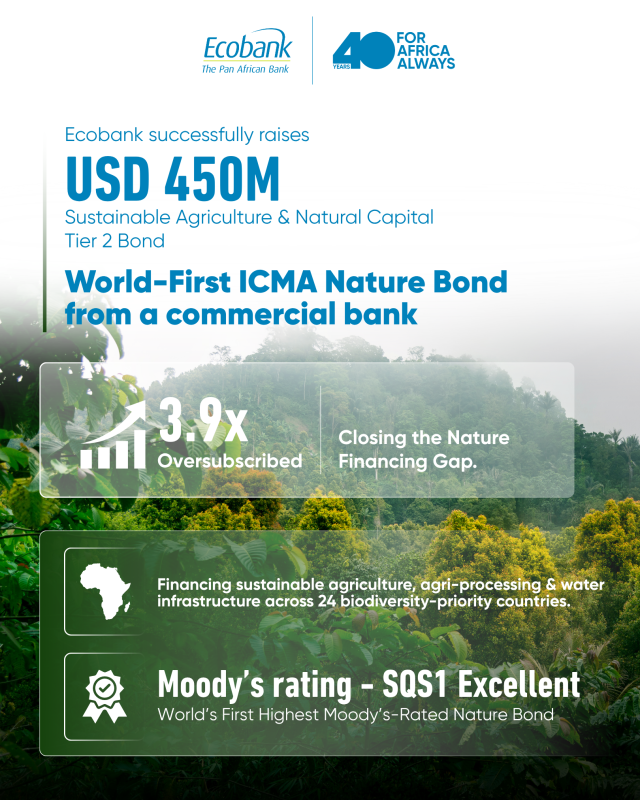
Ecobank’s Nature Bond is a direct response to this gap. It will support smallholder farmers adopting sustainable agricultural practices, agri-processors with verified deforestation-free supply chains, and water infrastructure protecting freshwater ecosystems relied upon by millions of people. Unlike many conservation-focused financing vehicles, Ecobank’s Nature Bond channels capital directly through Africa’s real economy — financing businesses and communities whose day-to-day activities shape environmental outcomes at scale.
The investments will be made in 24 markets, with significant deployment in biodiversity-priority countries such as Côte d’Ivoire, Burkina Faso and Ghana. Importantly, 81% of the eligible lending pool is allocated to countries where agricultural land-use change is the primary driver of biodiversity loss, helping direct capital to the areas where it can have the greatest environmental impact.
The framework also incorporates independent monitoring and verification mechanisms, including deforestation screening and supply chain traceability requirements, helping ensure that financed activities deliver measurable nature-positive outcomes. Every eligible loan carries seven independently verified sustainability conditions.
The launch of this bond also comes as governments and investors worldwide face mounting pressure to mobilise private capital for biodiversity protection and sustainable land use.
What is a Nature Bond?
A Nature Bond, under the ICMA secondary designation, requires proceeds to actively contribute to nature-positive outcomes, including transforming economic activities to reduce the drivers of nature loss at scale.
The Nature Bond was designed to reach those that conservation-focused instruments were not designed to serve – farmers, agri-processors and water operators whose daily activities collectively determine ecosystem outcomes.
While green bonds typically finance a broad range of environmental objectives, the Nature Bond designation focuses the use of proceeds specifically on nature-related outcomes, including biodiversity, sustainable agriculture, land use and water infrastructure.
The transaction
The USD 450 million bond was priced following strong investor demand with the final orderbook exceeding USD 1.36 billion – 3.9x the original target size. The strength of demand enabled Ecobank to increase the transaction by USD 100 million and tighten pricing by 50 basis points.
The transaction attracted support from both international and African investors, demonstrating Ecobank’s unique ability to mobilise capital across global and African markets.
For the first time, international and African capital markets have a credible, scalable mechanism for financing the protection of African natural capital through the communities who depend on it.
Jeremy Awori, Group Chief Executive Office, Ecobank Transnational Incorporated, commented:
“This transaction is a defining moment for African sustainable finance. Investors did not just support this bond. They demanded more of it, allowing us to increase the size and tighten pricing.
We are not a bank that simply labels bonds. We have spent four years building the systems, governance and accountability needed to make nature finance credible and scalable in Africa.
This bond is ultimately about the farmers, cooperatives and communities whose livelihoods depend on healthy ecosystems.”
Rachael Antwi, Group Head of Sustainability and ESRM, Ecobank Transnational Incorporated, added:
“Nature finance will only scale in Africa if it is practical, measurable and connected to the real economy. This bond is designed to do that by linking international capital to eligible lending for sustainable agriculture and water infrastructure across 24 countries. It reflects the systems and standards Ecobank has built to ensure nature finance supports both environmental resilience and the communities whose livelihoods depend on healthy ecosystems.”
2, Jun 2026
ITS America Conference & Expo Reveals Record 2026 Detroit Program
DETROIT, Mich. (June 2, 2026) — ITS America Conference & Expo, organized in partnership by RX Global and ITS America, has released its full program for the 2026 annual event, scheduled June 9-12 at Huntington Place in Detroit, Michigan, bringing together more than 3,000 transportation leaders from 23 countries, regions and territories to advance safer, smarter and more connected transportation systems.
The four-day expo, themed “Empowering Innovation,” features more than 100 conference sessions, plenary presentations led by industry visionaries, and state DOT roundtable discussions that give transportation leaders a platform to exchange strategies and share lessons from the field. Sessions cover topics ranging from connected vehicle deployment and AI-driven traffic management to accessible transportation and smart infrastructure. The exhibit hall, open June 10-12, will welcome close to 200 exhibitors and sponsors showcasing the latest advances in traffic management, autonomous mobility, connected vehicle systems and smart infrastructure.
New this year, the Cybersecurity & Data Zone brings together 10 exhibitors highlighting innovative solutions that protect connected vehicles and secure smart infrastructure as transportation networks become more digital and automated. Palo Alto Networks, one of the zone’s featured exhibitors, will present its AI-driven cybersecurity platforms designed to protect connected transportation infrastructure from evolving threats. The new StartUp Zone gives emerging companies a dedicated platform to introduce breakthrough technologies directly to decision-makers and procurement leaders. Start-up companies including Mobito, Neuweb, Inex.net, ASX, ViaSight and Intreelligent will bring a stronger presence to the show floor, representing the next generation of transportation innovation. Exhibiting alongside the industry’s most established players, these rising companies gain direct access to the agencies, investors and partners capable of moving their technologies from concept to real-world deployment.
“The ITS America Conference & Expo is where our industry comes to move forward, together,” said Laura Chace, President and CEO, ITS America. “The pace of change in transportation technology demands that leaders gather each year to share what works and build the relationships that drive real-world deployment. Detroit is the right city for this conversation, and the 2026 program reflects the depth, urgency and opportunity that defines this moment in mobility.”
This year’s event features a record number of outdoor demonstrations, sponsored by Integral Blue and located directly outside Huntington Place, offering five immersive experiences that bring intelligent transportation to life across Detroit. The I-94 Freeway Experience shows how V2X communication and cloud-based systems make high-speed travel safer and more efficient in real time, while the M-1 Intelligent Woodward Experience puts connected intersections and advanced sensors to work along Detroit’s iconic Woodward Avenue, demonstrating how vehicles, pedestrians and infrastructure communicate to improve urban safety and traffic flow.
On Thursday, June 11, Emergency Response Tech & Demo Day, brought to you by GFT Infrastructure Inc. and Michigan DOT sponsored by Skydio, connects the worlds of ITS and emergency response through live demonstrations featuring infrastructure-based V2X communications for incident scene warnings, drone delivery integration for emergency operations and a close-up look at an autonomous freight vehicle from TORC. Three Tech Tours, available on Tuesday, June 9, take small groups to active ITS facilities across the region, including a behind-the-scenes visit to Integral Blue’s Auburn Hills operations center where attendees witness live demonstrations of ITS equipment integration, V2X applications and network incident response that keep Michigan’s transportation systems running.
The Transportation Hub, sponsored by Palo Alto Networks and located on the exhibit hall floor, serves as the event’s destination for learning and networking. Attendees can join expert-led fireside chats, watch a live recording of the Transportation Channel Podcast and receive a complimentary professional headshot, all while connecting with peers and industry leaders shaping the future of transportation. The Future Leaders Program, sponsored by Southwest Research Institute (SwRI), connects students and young professionals with industry pioneers through essay competitions, hands-on workshops, campfire-style career development sessions and direct mentorship from transportation leaders.
“From the plenary stage to the exhibit floor to the streets of Detroit, attendees will see, experience and discuss the technologies reshaping how people and goods move across our communities,” said Jaime McAuley, Event Vice President, ITS America Events. “Every session, demonstration and Tech Tour is designed to give attendees practical knowledge and new perspectives they can bring home and put to work immediately. This is where the industry comes to learn what is next and how to get there.”
The conference draws architects, engineers, public agency officials, state departments of transportation, metropolitan planning organizations, investors and mobility innovators, representing a 50-50 split between the public and private sectors. Registration is open now at itsamericaevents.com.
2, Jun 2026
AD Ports Group Acquires CLI, Brazil’s Leading Agri-Bulk Port Terminal Operator, for over AED 3 Billion
São Paulo, Brazil, and Abu Dhabi, UAE – 2nd June 2026: AD Ports Group (ADX: ADPORTS), a leading global enabler of trade, industry, and logistics solutions, today acquired Corredor Logística e Infraestrutura (CLI), Brazil’s leading independent agri-bulk port terminal operator, entering the South American market with a strategically major expansion transaction.
São Paulo-based CLI operates two of Brazil’s most important agri-bulk export terminals under long-term concessions: CLI Sul, Brazil’s leading sugar export terminal and key export terminal for corn and soybeans, located in the Port of Santos; and CLI Norte, another key grains gateway at the Port of Itaqui, which is part of the Brazilian ‘Arc of the North’, an essential geographical region encompassing the Amazon basin that is a pivotal logistics hub and significant emerging corridor for agriculture exports.
In 2025, ports and terminals in northern Brazil recorded the fastest growth in the country, reinforcing the strategic role of the “Arc of the North’ corridor in reshaping the nation’s logistics map.
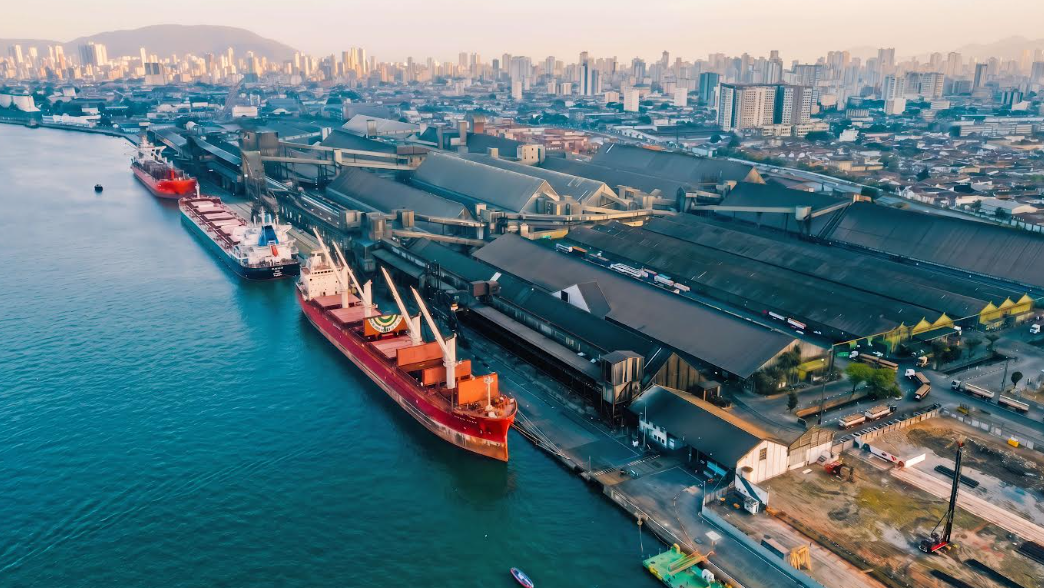
The two terminals play a key role in connecting the producing regions of Brazil, the world’s leading sugar exporter and one of the largest grain exporters, to the world.
AD Ports Group agreed to acquire CLI from joint owners Macquarie Asset Management, and IG4 Capital. CLI owns 100% of CLI Norte, which operates a terminal at the Port of Itaqui, and 80% of CLI Sul, which operates a terminal at the Port of Santos.
The transaction, which is expected to be completed in the second half of the year subject to customary closing conditions, including regulatory and antitrust approval, was conducted at an enterprise value of AED 3.1 billion (USD 835 million).
It has also been agreed that CLI’s existing senior management team will remain in place to continue running the company.
The CLI acquisition represents a transformative step for AD Ports Group, positioning it as one of South America’s leading independent agri-bulk terminal operators, with strategic access to a vast new number of opportunities for the Group’s associated businesses of maritime and shipping, logistics, economic cities, and digital services.
Captain Mohamed Juma Al Shamisi, Managing Director & Group CEO of AD Ports Group, said: “The purchase of CLI is a game changer for AD Ports Group. The transaction extends our Group’s international reach for the first time into Latin America, and deepens our growing agrifoods activities, one of our core verticals. Under the wise guidance of our leadership in the United Arab Emirates, AD Ports Group is committed to enabling trade in one of the world’s most-important, fastest-growing agricultural commodities markets, which will not only benefit the Group’s global clients, including those in Brazil, but also strengthen the AD Ports Group global network.”
Brazil supports AD Ports Group’s geographic expansion as well as the Group’s plan to develop a major new East-West trade spoke linking South America’s largest economy to the Indian Subcontinent, East Africa and Southeast Asia. The UAE is in advanced negotiations with Mercosur, the South American trading bloc that includes Brazil, to establish a Comprehensive Economic Partnership Agreement. Emirati investments in Brazil are estimated to be approximately USD 5 billion in total, according to the UAE Ministry of Foreign Affairs. The two countries maintain a highly active strategic partnership, having signed a Double Taxation Agreement and eliminated various tax and investment barriers to boost bilateral business.
Fernando Lohmann, Head of Macquarie Asset Management in Brazil, said: “Brazil’s agricultural export sector continues to demonstrate remarkable resilience, reinforcing the country’s position as one of the world’s leading suppliers of agricultural commodities. As a long-term investor in the country, Macquarie remains committed to acting as a responsible custodian of essential infrastructure assets that help drive economic development, improve connectivity and support Brazil’s role in global trade and we believe AD Ports Group is ideally positioned to support CLI’s next phase of growth.”
Paulo Todescan L. Mattos, Co-Founder, Managing Partner, and CEO of IG4 Capital, said: Since becoming shareholders in CLI, our focus has been on strengthening the company’s operational capabilities, expanding its strategic footprint, and positioning the platform to capture the long-term growth of Brazil’s agri-bulk export sector. We believe AD Ports Group is the right strategic owner to build on this foundation, bringing global trade expertise, infrastructure capabilities, and a long-term vision that will support CLI’s continued growth and development.”
The purchase of CLI gives AD Ports Group an entry point into Latin America, and a platform for further regional expansion. Moreover, the agrifood sector is a priority vertical in the Group’s intelligent internationalisation expansion strategy, with several key investments made in that space recently.
In December 2025, the Group’s Karachi Gateway Multipurpose Terminal Ltd. (KGTML) and the Pakistan unit of global merchant and agricultural goods processor Louis Dreyfus Company signed a long-term agreement to develop a clean bulk handling and storage facility for agricultural goods at Karachi Port. In January 2025, the Group agreed to invest about USD 30 million in the greenfield Sarzha Grain Terminal on the Caspian Sea at Kuryk Port in Kazakhstan and earlier this year, the Group secured a 30-year concession to operate the Aqaba multipurpose port in Jordan, which is a key player in agri-bulk in the Middle East with over 3 million tonnes of grains handled annually. Moreover, Noatum Ports’ Spanish operations are already significantly involved in agri-bulk with the Tarragona and Sagunto terminals handling around 2 million tonnes of grain imports annually and with an additional investment of AED 90 million (EUR 21 million) announced recently for modernising existing facilities at the Tarragona terminal.
In 2025, CLI handled a combined 17 million tonnes of agri-bulk cargo and delivered a revenue of AED 654 million (USD 178 million), generating an EBITDA of AED 360 million (USD 98 million).
CLI operates one of Brazil’s few large-scale, agri-bulk port platforms, strategically located along export corridors and ports. The ports of Santos and Itaqui are structurally constrained, particularly in Santos, where limited expansion capacity and chronic congestion are expected to underpin long-term utilisation and pricing resilience.
Long-term demand for the Group’s Brazilian terminals is also supported by Brazil’s global leadership and the strategic importance of the country’s grain and sugar exports. Brazil is the world’s largest sugar exporters, accounting for 40-50% of total global sugar exports, according to industry figures, and a leader in soybeans, coffee, and corn.
The purchase of CLI is AD Ports Group’s largest acquisition to date following the Group’s AED 2.65 billion (USD 720 million) purchase of Spain’s Noatum in 2023, and its AED 1.9 billion (USD 510 million) purchase of a 51% stake in Dubai-based Global Feeder Shipping (GFS) in early 2024.
For the transaction, AD Ports Group was advised by BTG Pactual, while IG4 and Macquarie Asset Management were advised by Citi.
2, Jun 2026
Ozen Life Maadhoo Reimagines the Maldives Through the Art of Slow Luxury
For discerning traveller, the resort offers an experience of stillness, indulgence and beautifully unhurried island living

June 6: As luxury travellers increasingly seek privacy, presence and experiences with emotional depth, OZEN LIFE MAADHOO emerges as a rare kind of escape, one where time slows, the senses awaken, and every detail is designed for a more meaningful kind of indulgence in the Maldives.
Luxury today is no longer defined by excess alone, but by the freedom to experience a destination more deeply, more privately, and at one’s own pace. For affluent Indian travellers who increasingly value immersive escapes over hurried itineraries, slow travel has become the new marker of sophistication. At OZEN LIFE MAADHOO, set within the serene beauty of South Malé Atoll, this philosophy unfolds naturally through expansive ocean views, intuitive service, and a sense of calm that begins the moment one arrives on the island.
At the heart of the experience is the resort’s signature INDULGENCE™ Plan, a thoughtfully crafted concept that allows guests to surrender to the pleasures of island life without interruption. Days begin with leisurely Champagne breakfasts at THE PALMS and unfold into a choice of richly layered experiences; snorkelling in crystalline waters, restorative rituals at ELE | NA Elements of Nature Spa, tranquil moments in a private villa, or sunset voyages across the Indian Ocean. Dining is integral to the rhythm of the stay, from refined Far Eastern flavours at TRADITION PEKING and soulful heritage cuisine at TRADITION INDOCEYLON to reimagined Maldivian expressions at LONU. At M6m, the resort’s iconic underwater restaurant, contemporary seafood is served against a mesmerising panorama of marine life, transforming dinner into theatre.
“The most meaningful luxury today is the luxury of feeling completely present,” says Mei P. Pun, General Manager of OZEN LIFE MAADHOO. “We are seeing a growing desire among travellers for journeys that restore, inspire and allow space for genuine connection. At OZEN LIFE MAADHOO, that sense of ease is woven into the island itself—through immersive dining, intuitive wellness, ocean-led experiences and the rare pleasure of unhurried time.”
The villas at OZEN LIFE MAADHOO are designed as sanctuaries of quiet refinement, where architecture and landscape exist in seamless conversation. The beachfront Earth Villas are nestled within tropical gardens, while the overwater Wind Villas open onto uninterrupted Indian Ocean views and expansive private decks above the lagoon. For families or guests seeking greater seclusion, the Earth Pool Pavilion and THE OZEN RESIDENCE offer exceptional privacy, generous proportions and an effortless sense of exclusivity.
At OZEN LIFE MAADHOO, slow luxury is not a trend statement, but an elegant way of experiencing the Maldives—defined by space, beauty, privacy and the freedom to linger. For the modern Indian traveller seeking a journey that feels both indulgent and deeply personal, the resort offers not simply a holiday, but a return to life’s most exquisite pace.
Where time softens, the ocean shimmers, and every moment is crafted to be savoured.
2, Jun 2026
Veteran GCC leader brings 20-plus years of global operations experience to Barry-Wehmiller
CHENNAI, India — June 2 — Barry–Wehmiller is pleased to announce the appointment of Sukumar Bhasker as Vice President – Global Competency Center (GCC), based in Chennai, India. In this role, Sukumar will lead the continued growth, capability-building and strategic evolution of Barry–Wehmiller’s GCC, strengthening its role as a critical engine for global innovation, engineering excellence and shared services delivery.
Sukumar joins Barry–Wehmiller with more than two decades of global experience in building, scaling and transforming Global Business Services (GBS) and GCC operations across geographies, including India, China, Mexico and Romania.
Most recently, he served as Partner, Technology Consulting (GCC/GBS), at EY, where he advised global organizations on setting up and scaling technology and business service centers. Prior to that, Sukumar spent several years at Flex, where he led global IT GCC operations, overseeing a workforce of more than 1,500 team members and driving enterprise-wide digital transformation, process excellence and talent initiatives.
Throughout his career, Sukumar has demonstrated a strong ability to align business strategy with technology innovation, leading initiatives in artificial intelligence, machine learning, automation, data platforms and digital transformation. He has also been deeply committed to building high-performing teams, driving team member engagement and championing diversity, equity and inclusion.

“Sukumar brings a unique blend of global experience, operational depth and a strong people-first mindset,” said Carol O’Neill, Chief Transformation Officer, who leads Barry–Wehmiller’s GCC strategy. “His track record of building and transforming large-scale global centers, combined with his focus on developing people and strengthening culture, makes him the right leader to take our GCC to the next phase of growth.”
“I am honored to join Barry–Wehmiller, a company renowned for its people-centric culture and commitment to meaningful leadership,” said Sukumar. “As a GCC leader in India, I look forward to driving innovation, fostering collaboration and empowering our teams to create lasting impact together. Here’s to a journey of growth, purpose and shared success.”
In his new role, Sukumar will focus on expanding the GCC’s capabilities, deepening its integration with Barry–Wehmiller’s global platforms and enabling innovation-led growth while continuing to build a strong, people-focused culture.
He holds a Bachelor of Engineering in electronics and communication engineering and a Master of Business Administration with an emphasis in operations management. He has completed multiple professional certifications, including an Advanced Diploma in GBS (CIMA) and a Certified Corporate Director (IOD) designation.
2, Jun 2026
Air Canada Cargo Selects CHAMP Cargospot neo to Enhance Digital Operations
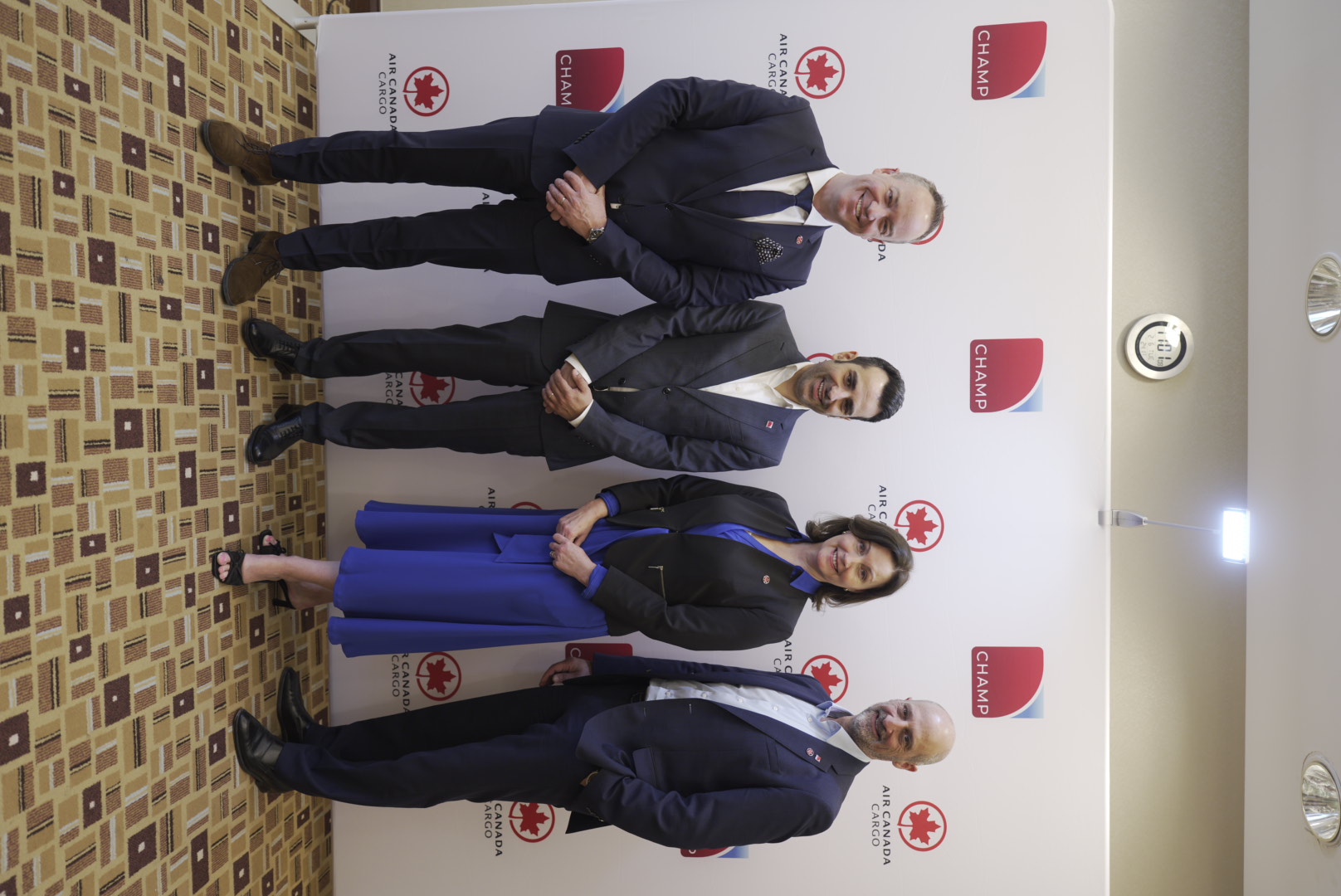
Warsaw, June 2: CHAMP Cargosystems’ Cargospot neo has been selected by Air Canada Cargo, Canada’s largest air cargo provider as measured by cargo capacity, as the core of its new cargo management system, spanning operations, commercial, and selected revenue accounting functions. The award follows a competitive tender to modernize technology across Air Canada Cargo’s global network and simplify its IT landscape. It will boost operational efficiency, and deliver a more transparent, responsive experience for customers and partners across the cargo lifecycle.
At the heart of this transformation is Cargospot neo Airline, CHAMP’s reimagined flagship cargo management system. It runs on the state‑of‑the‑art CHAMP neo Platform, featuring an API‑native architecture. In addition to Cargospot neo Airline, Air Canada Cargo will also integrate Cargospot neo Handling, Cargospot Mobile and Cargospot neo Revenue Accounting to streamline operations and operate a fully connected, real-time model.
Together, Cargospot neo, TGC, TGS, and Traxon CDMP provide an integrated digital foundation that supports Air Canada Cargo’s long‑term strategy to strengthen resilience, deliver end-to-end shipment visibility, and provide consistent, premium service to their customers worldwide.
Nicholas Xenocostas, Chief Commercial Officer at CHAMP commented,
“We are proud to support Air Canada Cargo on this journey. Cargospot neo was designed to connect commercial, operational, and financial teams in real-time so that airlines can improve cargo visibility, serve customers better, and adapt more quickly in a complex and ever-changing global environment.”
“Air Canada Cargo is setting a clear benchmark for what modern, customer‑centric cargo operations look like,” added Manuel Galindo, Chief Executive Officer at CHAMP Cargosystems. “With Cargospot neo, they are not just replacing legacy technology. Air Canada is redefining how commercial insights, operational execution, and financial accuracy come together in real-time. We are proud to partner with Air Canada Cargo on this transformation and to support their teams with a platform built for scale and continuous innovation across the entire air cargo ecosystem.”
2, Jun 2026
Chowman Strengthens its Mumbai Presence with a New Flavorsome Outlet in Ghansoli

Following the successful Mumbai launch last year, Chowman, Kolkata’s beloved Chinese restaurant chain is expanding deeper into Mumbai’s suburban heartland of flavors with a new restaurant in Ghansoli. With this Chowman is proud to mark its fourth foray in the City of Dreams, complementing its existing outlets in Andheri West, Mira Road and Powai (Cloud Kitchen).
Nestled in Alliance One, Sector 5 in Ghansoli, the new outlet brings Chowman’s signature blend of authentic Asian cooking and intimate dining ambiance to the region. The 36-seater restaurant maintains the brand’s distinctive identity of red-and-black interiors, warm lighting, and carefully curated oriental aesthetics creating an inviting space for everything from quick weeknight dinners to thoughtful family gatherings.
The epicurean menu features both vegetarian and non-vegetarian savors, with their Piece de Resistance reflecting Chowman’s commitment to culinary authenticity. Diners can relish the flavors of carefully crafted Stir Fried Pak Choi in Chilli Garlic Sauce, Steamed Fish in Chinese Greens, and the signature Prawn Balls, alongside house specials like Clay Pot Braised Chicken with Mushroom, Bangkok Street Noodle Bowl, Kolkata-Style Chilli Chicken, and traditional Khao Suey. Each dish is prepared using authentic recipes and premium ingredients, ensuring every visit feels like a curated culinary journey.
Brimming with excitement for the launch of the new outlet, Mr. Debaditya Chaudhary, Managing Director of Chowman said, “The Ghansoli opening is a natural progression in our growth across Mumbai. Over the past decade and a half, we’ve built Chowman on the foundation of uncompromising quality in ingredients, technique, and hospitality. And we’re excited to bring that same standard of authentic Chinese dining to the neighborhood of Ghansoli. We’re not just opening another restaurant; we’re bringing a dining philosophy that believes good food should never be a compromise. The Ghansoli community can expect the same rigour and passion that our Kolkata guests have come to love, served with the warmth and professionalism our Mumbai customers have come to expect.”
For the seasoned explorers of Chinese cuisine or the curious first timers, with family, friends or colleagues for a relaxed dinner, weekend outings or family celebrations, Chowman continues to follow the motto of ‘Serving Happiness Nationwide’.
Where: Location: Shop No. 3, Alliance One, Plot No 1 & 2, Sector 5 & 4, Ghansoli, Navi Mumbai, Maharashtra – 400701
Cost for Two: INR 1000 plus taxes
Time: 12 Noon – 10:30 PM
2, Jun 2026
Servotech Renewable Signs INR 400 Crore MoU with Haryana Govt. to Expand Renewable Energy Manufacturing Capacity in the State
New Delhi, June 02: Servotech Renewable Power System Ltd., India’s leading manufacturer of solar and renewable energy solutions, has signed a Memorandum of Understanding (MoU) with the Haryana Enterprises Promotion Centre (HEPC), Department of Industries & Commerce, Government of Haryana, to expand its expand its manufacturing and warehousing operations in the state with a proposed investment of approximately ₹400 crore. The investment is expected to generate around 500 direct/Indirect employment opportunities.
The MoU was signed in the presence of Hon’ble Chief Minister of Haryana Shri Nayab Singh Saini at the official launch of the ‘Make in Haryana’ Industrial Policy 2026, held in Gurugram on 1st June 2026. The launch event also unveiled a compendium of nine sectoral policies aimed at positioning Haryana as a preferred destination for industrial and clean-energy investments.
Under the agreement, Servotech Renewable and HEPC will establish a framework for collaboration and cooperation to facilitate the company’s proposed expansion plans in Haryana. The project is expected to attract an investment of approximately ₹400 crore and generate around 500 employment opportunities, contributing to the state’s industrial and economic growth.
The proposed investment will be deployed in a phased manner over the next 24 to 36 months and will support the expansion of Servotech’s manufacturing capacity across EV chargers, solar products, Battery Packs, BESS and Power electronics, sectors identified as thrust areas under the Make in Haryana Industrial Policy 2026. The expansion is intended to scale production capacity, improve operational efficiencies, deepen import substitution, and strengthen the Company’s ability to serve growing domestic and export demand. Specific site selection within Haryana is under evaluation.
As part of the MoU, the Haryana Government, through HEPC, has committed to providing facilitation support and ease-of-doing-business assistance for the successful implementation of the proposed investment. The collaboration reflects the shared objective of accelerating industrial development, promoting clean energy manufacturing, and strengthening Haryana’s position as a hub for sustainable growth and innovation.
Commenting on the development, Raman Bhatia, Managing Director, Servotech Renewable Power System Ltd., said, “We are delighted to partner with the Government of Haryana. Haryana has emerged as one of India’s most progressive investment destinations, and the launch of the Make in Haryana Industrial Policy 2026 reinforces the state’s commitment to industrial growth, clean-energy manufacturing and innovation. Our proposed ₹400 crore investment aligns with Servotech’s long-term vision of scaling renewable energy manufacturing capabilities and is a meaningful step towards our stated ambition of reaching ₹1,500 crore in revenue by FY 2027. We believe this collaboration will strengthen our operational footprint and contribute to Haryana’s clean-energy ambitions and broader economic development.”


